


From architectural color blocking to vintage-inspired bedrooms, discover how olive green creates spaces that feel sophisticated, comfortable, and personal.
- What Makes Olive Green Different From Other Bedroom Greens?
- 12 Olive Green Bedroom Ideas for Different Interior Styles
- 1. Pair olive green with walnut in a mid-century modern bedroom
- 2. Paint the ceiling olive green and keep the walls warm white
- 3. Create a small olive green bedroom with built-in furniture
- 4. Combine dark olive green with burgundy for a vintage bedroom
- 5. Design an architectural olive green and travertine bedroom
- 6. Use olive green bedding in a bright cottage bedroom
- 7. Bring back 1970s character with olive green and ochre
- 8. Create a desert-modern bedroom with olive and saddle leather
- 9. Give olive green a graphic modern look with charcoal
- 10. Soften olive green with faded blue and cream
- 11. Turn an olive green bedroom into an art-filled retreat
- 12. Design a tailored olive green guest bedroom with twin beds
- The Best Colors to Pair with Olive Green in a Bedroom
- How to Choose the Right Olive Green Paint
- Check whether the olive is yellow, brown, or gray leaning
- Test olive green against existing furniture
- Pay attention to natural light
- Understand light reflectance value
- Test a large sample before painting the entire room
- Where Should You Use Olive Green in Your Bedroom?
- The Wallsaide Olive Green Balance Test
- Olive Green Bedroom Ideas on a Budget
- Common Mistakes When Decorating with Olive Green
- Using several incompatible olive shades
- Making every surface dark
- Choosing cool white when warm white would work better
- Adding too many earthy accents
- Copying a room without considering its architecture
- Frequently Asked Questions
- Is olive green a good color for a bedroom?
- What colors go well with olive green bedroom walls?
- Does olive green make a bedroom look smaller?
- Is olive green or sage green better for a bedroom?
- What color bedding looks best with olive green walls?
- Can I use olive green in a modern bedroom?
- What wood furniture works with olive green?
- Final Thoughts
- About the Author
Olive green bedroom ideas bring an earthy richness that lighter greens don’t always provide. Whether you use olive on painted walls, upholstered furniture, wardrobes, or bedding, it pairs beautifully with walnut, cream, warm beige, terracotta, and other natural finishes.
The key is choosing the right undertone and balancing its visual weight. A yellow-leaning olive can feel warm and retro, while a deeper brown-green olive creates a more dramatic atmosphere.
These 12 bedroom designs show how to use olive green across different styles, room sizes, and budgets.
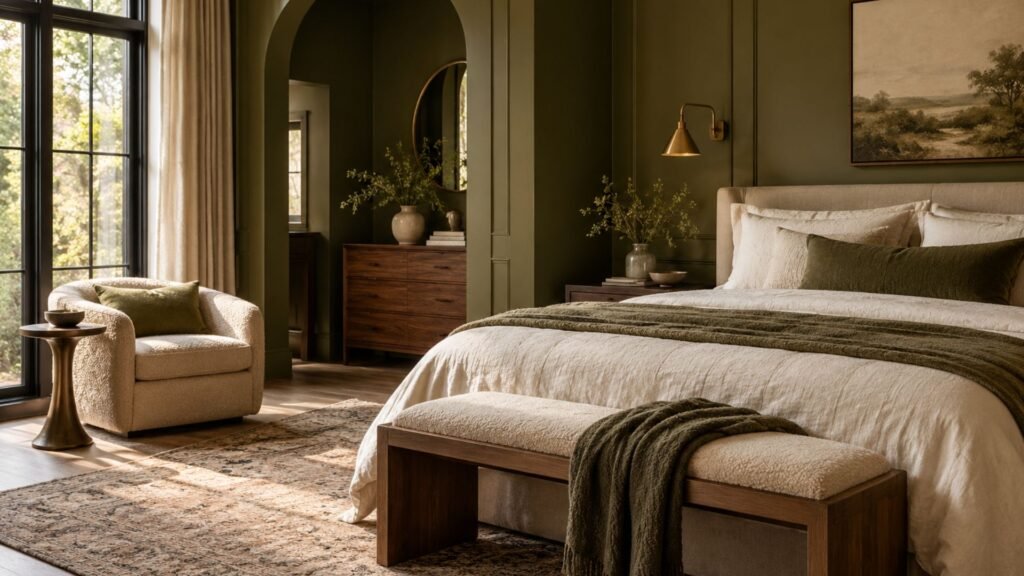
What Makes Olive Green Different From Other Bedroom Greens?
Olive green has an earthy quality that often comes from its yellow, brown, or gray undertones. Compared with many sage greens, olive typically feels deeper, warmer, or more grounded.
However, olive isn’t one standardized shade. A muted olive may look almost neutral beside brown furniture, while a stronger yellow-green can become the main visual statement.
That distinction matters when choosing finishes.
Walnut furniture can reinforce olive’s richness. Pale oak creates contrast and makes it feel more contemporary. Cream and warm white add lightness, while terracotta and ochre emphasize its earthy character.
If you’re comparing the broader color family, explore our green bedroom ideas guide. For softer, grayer greens, see sage green bedroom ideas.
Olive green is particularly effective when you want your bedroom to feel established and characterful rather than overly polished.
12 Olive Green Bedroom Ideas for Different Interior Styles
The following designs explore distinctly different approaches, from understated modern bedrooms to expressive vintage interiors. Each uses olive green differently, allowing you to choose a concept that works with your architecture and existing furniture.
1. Pair olive green with walnut in a mid-century modern bedroom
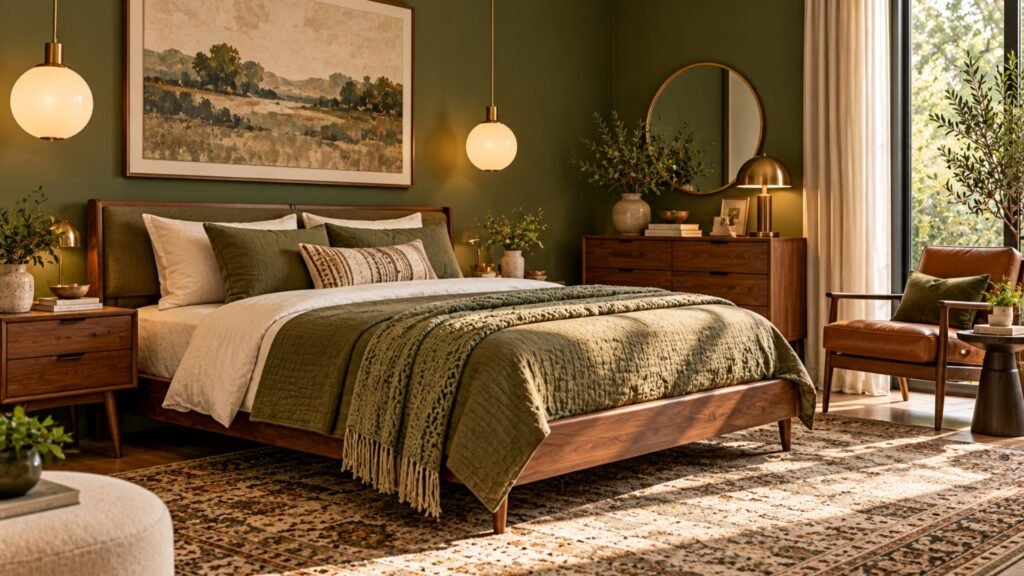
Olive green works naturally with the warm wood tones and simple furniture silhouettes associated with mid-century design.
A low walnut bed against an olive wall creates an immediate focal point. Add a slim wooden dresser, a globe-shaped pendant, and an occasional chair in cognac leather.
The design benefits from furniture with visible legs and clean proportions rather than oversized upholstered pieces.
A vintage-inspired rug can introduce restrained pattern and prevent the combination of dark wood and green from feeling too uniform.
Why it works: Olive and walnut share an earthy character, while cream bedding and metal lighting introduce enough contrast to define the furniture.
Recreate the look: Use olive across one or two walls, choose walnut or teak-style furniture, and add an ivory duvet. Keep decorative objects limited to a few pieces with sculptural shapes.
2. Paint the ceiling olive green and keep the walls warm white
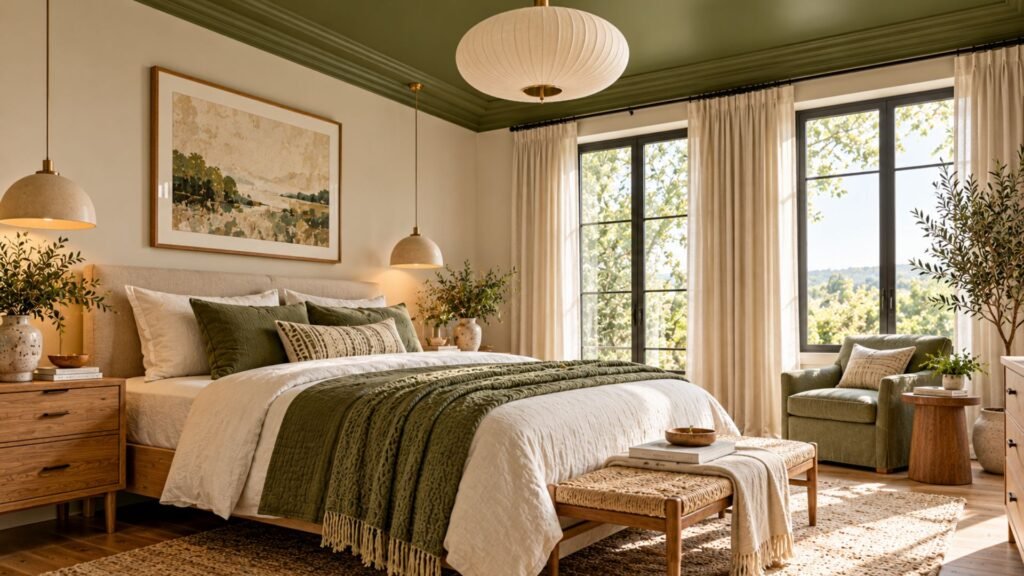
Not every olive green bedroom needs green walls.
A painted ceiling can introduce strong architectural color while allowing the walls to remain light.
This approach is particularly interesting in rooms with good ceiling height, simple wall treatments, and generous daylight.
An olive ceiling above warm white walls creates a clear division between color and neutral surfaces. Pale oak furniture and light bedding keep the lower part of the room visually open.
Why it works: The ceiling becomes the defining feature, so the remaining furniture can stay relatively simple.
Recreate the look: Choose a muted olive that complements the flooring and window frames. Paint the ceiling and, if appropriate, a narrow section of upper molding in the same shade. Use minimal furniture and avoid adding competing wall patterns.
3. Create a small olive green bedroom with built-in furniture

Olive green bedroom ideas for small spaces should combine visual appeal with practical storage.
In a compact room, an olive-painted storage wall can accommodate wardrobes, drawers, and a recessed headboard area.
This creates one cohesive furniture composition instead of multiple individual cabinets competing for floor space.
Integrated bedside lighting and slim shelves can replace freestanding nightstands where space is restricted.
The goal isn’t to conceal every object. It’s to organize the room around a few well-planned elements.
Why it works: Painting the fitted storage a single color reduces visual fragmentation, while lighter bedding separates the sleeping area from the cabinetry.
Recreate the look: Use flat-front olive wardrobes, concealed handles, warm integrated lighting, and ivory bedding. Ensure cabinet depth and door openings work with the room’s circulation before committing to fitted furniture.
Our small bedroom ideas guide explains furniture scale and circulation in more detail.
4. Combine dark olive green with burgundy for a vintage bedroom
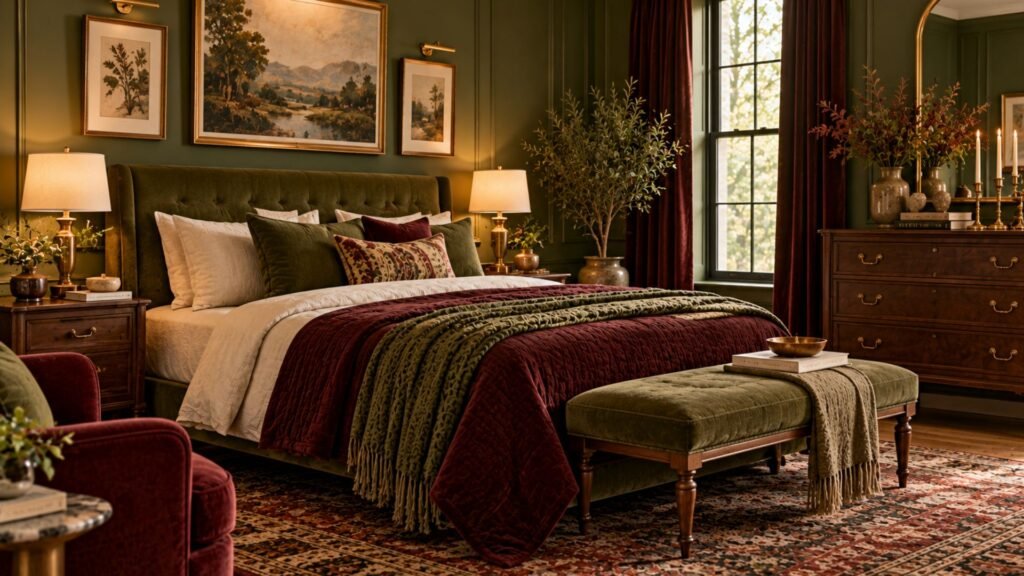
Olive and burgundy create an especially rich combination.
The two colors have enough contrast to remain distinct, but their muted intensity allows them to work together without appearing overly bright.
In a vintage-inspired bedroom, deep olive walls can provide a backdrop for burgundy velvet, antique mahogany furniture, and warm brass fittings.
A traditional rug can connect the colors, particularly if it contains muted red, olive, cream, and brown.
Why it works: Burgundy introduces warmth and visual depth, while olive provides a quieter background for the furniture.
Recreate the look: Use burgundy mainly through the bedspread, cushions, or an upholstered chair. Balance the darker elements with cream bedding and thoughtful lighting.
Avoid covering every surface with rich color. The contrast is more effective when lighter areas remain visible.
5. Design an architectural olive green and travertine bedroom

For a contemporary approach, combine olive green with the pale, mineral quality of travertine.
An olive plaster wall adds color and subtle surface variation, while a low-profile bed and floating stone bedside ledges keep the overall composition architectural.
The room doesn’t need much decoration because the materials themselves create visual interest.
Brushed metal or dark bronze lighting can add a precise contemporary detail without overwhelming the palette.
Why it works: Pale stone creates contrast against earthy olive, while simple furniture allows texture and proportion to become the defining features.
Recreate the look: Choose one olive feature wall, a low upholstered bed, and stone or stone-look bedside surfaces. Keep bedding in ivory, oatmeal, or warm gray.
This direction also works with our broader modern bedroom ideas approach, where simplicity is balanced by material quality.
6. Use olive green bedding in a bright cottage bedroom
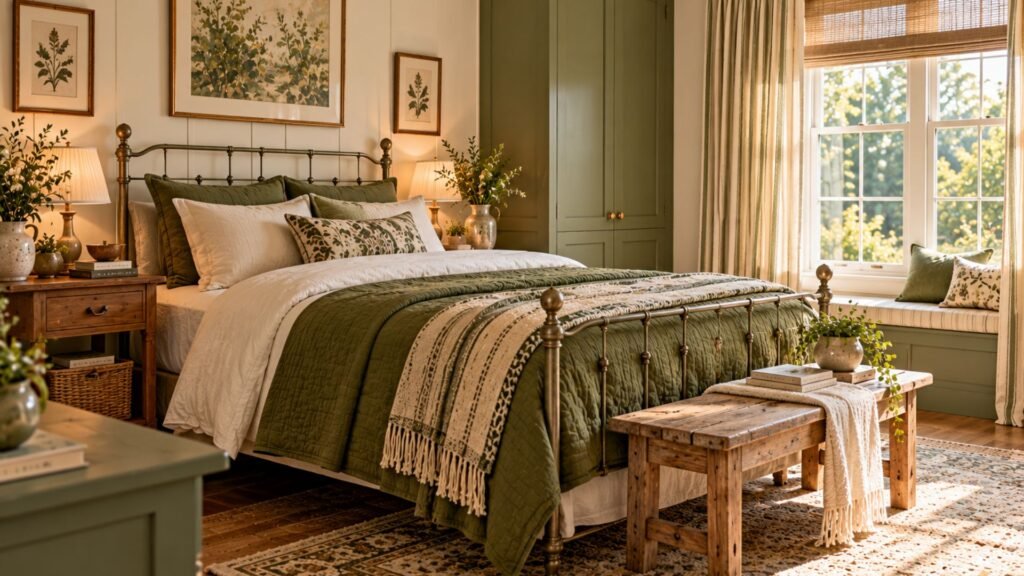
Olive green doesn’t need to dominate the architecture.
In a cottage bedroom with pale walls, an olive quilt can become the main color feature.
Add a traditional iron bed, striped curtains, and a weathered wooden bedside table for a relaxed, collected atmosphere.
This is a useful approach when you already have light-colored walls and don’t want to repaint.
An olive quilt with visible stitching can provide both texture and color.
Why it works: The pale room gives the green enough contrast to become noticeable without requiring multiple matching accessories.
Recreate the look: Choose olive bedding, warm white sheets, a soft patterned curtain, and one wooden bedside piece. Avoid repeating the exact olive tone in every decorative object.
7. Bring back 1970s character with olive green and ochre
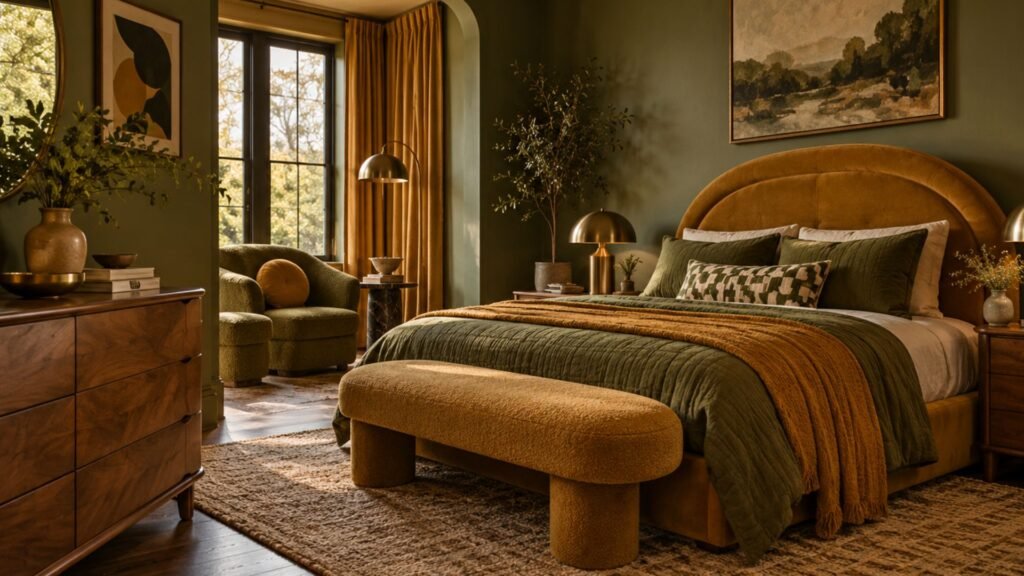
Olive green and ochre create an expressive combination with a strong retro influence.
Unlike a restrained mid-century bedroom, this approach embraces bolder shapes, richer color blocks, and statement lighting.
An ochre upholstered bed against olive walls becomes the primary visual feature.
Honey-toned wood and smoked glass reinforce the atmosphere without requiring excessive ornamentation.
A graphic rug can introduce a controlled pattern beneath the bed.
Why it works: The colors share warm undertones, but their different brightness levels help define separate areas of the room.
Recreate the look: Use olive on a geometric wall treatment, add an ochre headboard, and select one sculptural vintage-inspired lamp.
Keep the remaining bedding relatively neutral so the palette doesn’t become visually crowded.
8. Create a desert-modern bedroom with olive and saddle leather
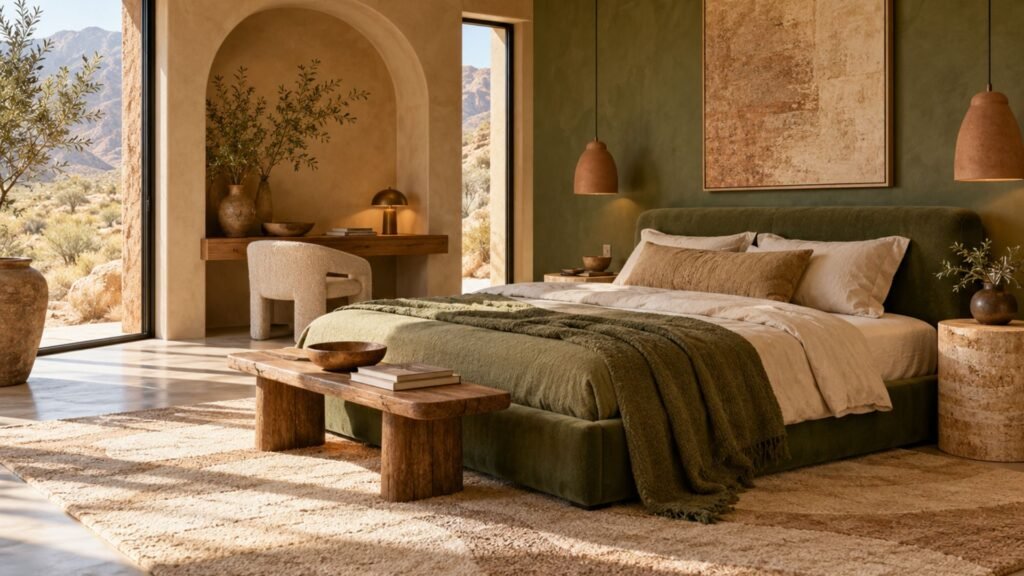
A desert-modern bedroom brings olive green together with warm clay, natural leather, and tactile surfaces.
The design can use muted olive through cabinetry or wall panels, leaving the remaining architecture in warm adobe or sand tones.
A saddle leather bed introduces another earthy material, while textured artwork and woven pieces reinforce the natural palette.
Unlike a heavily rustic bedroom, the furniture should have relatively simple, contemporary shapes.
Why it works: Olive provides a cooler counterpoint to clay and leather, making the warm materials feel balanced rather than overwhelming.
Recreate the look: Combine muted olive, sand-colored walls, saddle leather, and a small amount of dark metal. Choose woven textiles with visible texture instead of brightly patterned accessories.
9. Give olive green a graphic modern look with charcoal
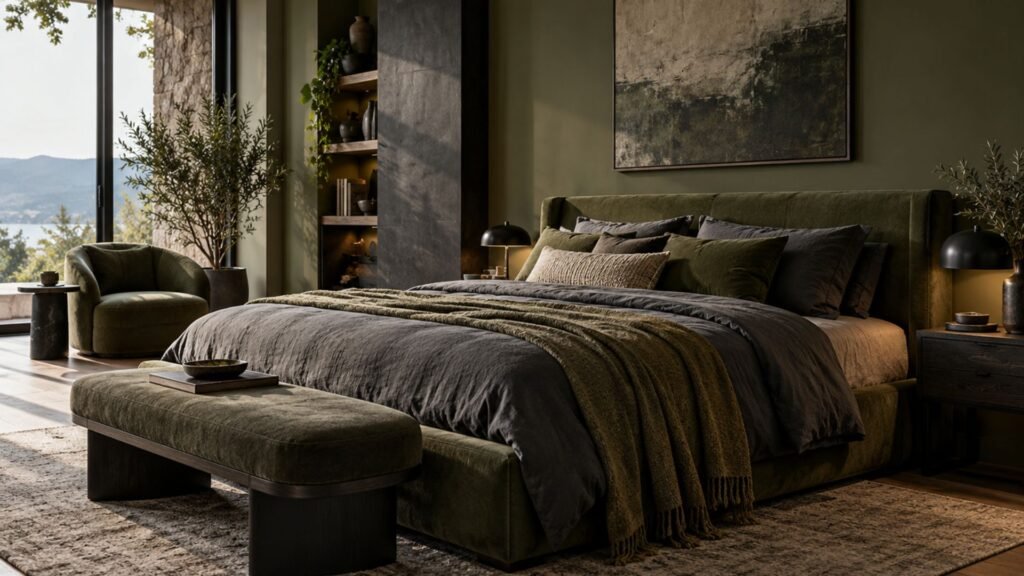
Olive green can feel strikingly contemporary when paired with charcoal and black.
Instead of using botanical prints or warm country furniture, create a composition defined by strong horizontal and vertical lines.
Olive-painted wall panels provide color, while a charcoal bed and black lighting create a more graphic silhouette.
Crisp ivory bedding prevents the darker elements from merging into one heavy block.
Why it works: The combination creates clear contrast without relying on bright accent colors.
Recreate the look: Use a clean-lined charcoal bed, one olive architectural feature, and minimal black metal details.
Avoid introducing too many other finishes. The design works best when the palette remains deliberate.
10. Soften olive green with faded blue and cream
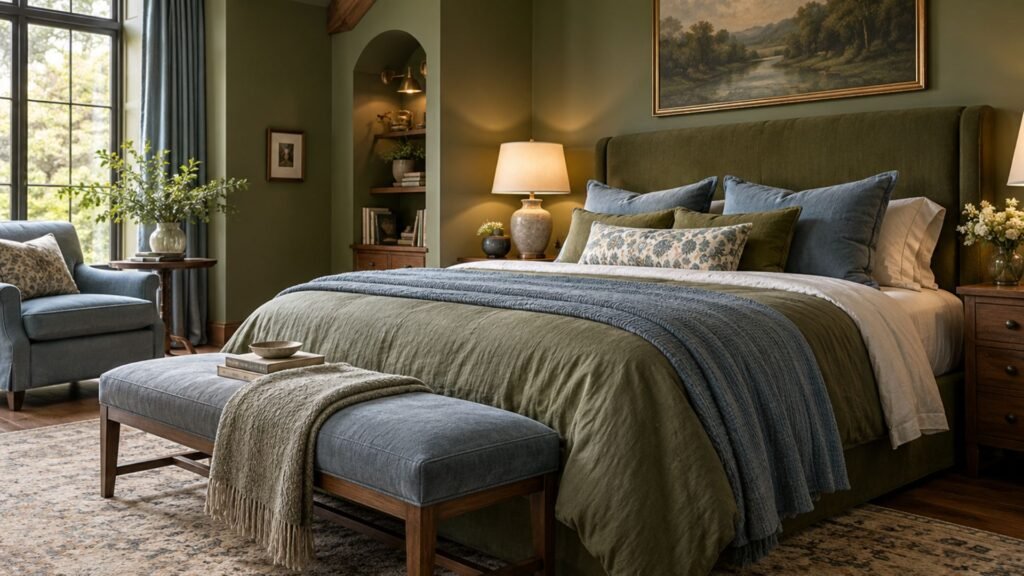
Olive green and faded blue can create an unexpected but balanced bedroom palette.
The important decision is choosing blue with a muted, slightly gray quality rather than a highly saturated electric shade.
Against olive walls, faded blue upholstery or a patterned rug can introduce cooler contrast.
Cream bedding and light oak furniture provide a neutral foundation that connects the two colors.
Why it works: Blue introduces a different color temperature without competing with olive’s earthy character.
Recreate the look: Let olive dominate the walls, use faded blue in one substantial element, and repeat both colors subtly in artwork.
Check actual fabric and paint samples together before selecting the final combination.
11. Turn an olive green bedroom into an art-filled retreat
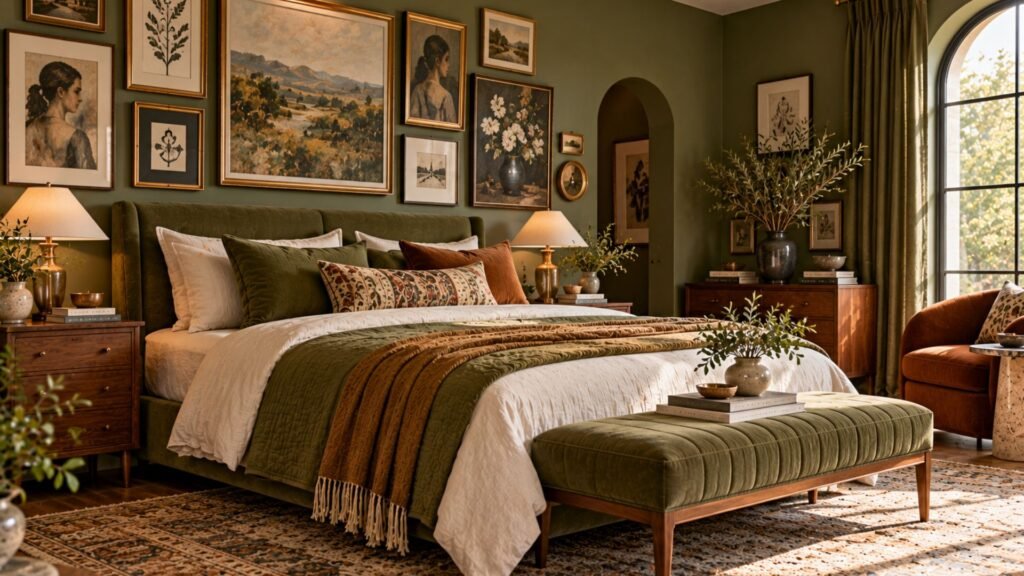
An olive green bedroom can become a beautiful backdrop for expressive artwork.
Rather than building the room entirely around furniture, use an olive wall to display one oversized abstract painting or a carefully composed collection.
A white or cream upholstered bed creates visual relief beneath the artwork.
A small cherry-red accent, sculptural side table, or unusual lamp can introduce personality without changing the entire palette.
Why it works: Olive provides a grounded background that allows artwork and sculptural objects to stand out.
Recreate the look: Start with artwork you genuinely like. Choose one accent color from the painting, repeat it once or twice, and keep the remaining furniture relatively simple.
The goal is a room that feels curated, not crowded.
12. Design a tailored olive green guest bedroom with twin beds
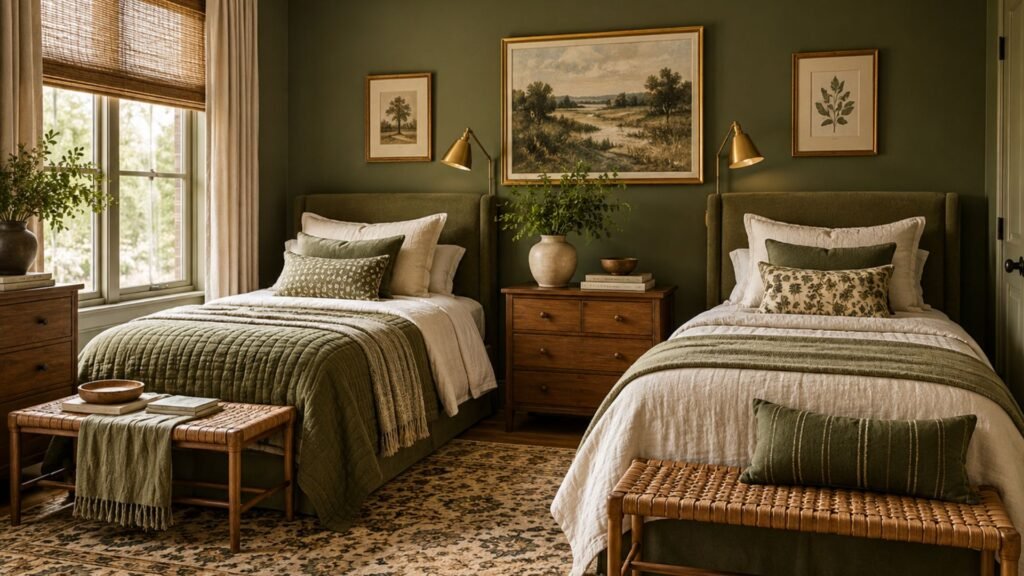
A twin guest bedroom offers an opportunity for deliberate symmetry.
Two wooden beds against olive green lower wall paneling create a coordinated look without requiring heavily upholstered furniture.
A shared bedside table and matching brass sconces help organize the arrangement.
Cream striped bedding adds a subtle pattern, while the upper walls remain warm white to prevent the room from feeling too dark.
Why it works: Repeated furniture creates visual order, while the olive paneling connects both beds into a single composition.
Recreate the look: Choose similar bed frames, a shared nightstand where spacing allows, matching reading lights, and a simple olive-and-cream palette.
Leave enough clearance between the beds for guests to move comfortably and access their belongings.
The Best Colors to Pair with Olive Green in a Bedroom
One of the advantages of olive green bedroom ideas is how easily the color works with natural materials and muted accent shades.
However, different pairings produce very different results.
| Color combination | Overall atmosphere | Materials that work well |
|---|---|---|
| Olive + walnut + ivory | Rich and sophisticated | Walnut, linen, brass |
| Olive + cream + oak | Warm and balanced | Oak, wool, ceramic |
| Olive + burgundy | Moody and vintage | Velvet, mahogany, aged brass |
| Olive + terracotta | Earthy and relaxed | Clay, leather, woven textiles |
| Olive + charcoal | Graphic and modern | Matte metal, dark upholstery |
| Olive + ochre | Retro and expressive | Honey-toned wood, smoked glass |
| Olive + faded blue | Soft and distinctive | Linen, painted wood, textiles |
Olive green and cream
Cream is one of the most adaptable partners for olive because it provides lightness without creating the stark contrast of a cool white.
Use cream on bedding, curtains, or large upholstered pieces when your olive walls are relatively dark.
Our cream bedroom ideas guide explores how to manage warm undertones and keep pale interiors from feeling flat.
Olive green and brown
Brown can strengthen olive’s earthy character.
A walnut bed creates richness, while pale oak makes the same green feel lighter and more contemporary.
If you’re working with existing dark furniture, see our brown bedroom ideas for ways to balance wood tones, upholstery, and surrounding colors.
Olive green and black
Black works best when used as a deliberate outline or accent.
Metal bed frames, picture frames, wall lights, and small cabinet handles can help give an olive bedroom a more modern appearance.
Avoid making every major piece dark unless you specifically want an enveloping, low-contrast interior.
How to Choose the Right Olive Green Paint
Choosing the right olive paint is more important than copying a photograph.
Two colors marketed as olive green can look completely different when placed beside your flooring, wood furniture, and bedding.
Check whether the olive is yellow, brown, or gray leaning
A yellow-leaning olive often feels warmer and more expressive.
A brown-leaning olive may create a deeper, earthier atmosphere, particularly beside walnut or tan leather.
A gray-muted olive can feel more restrained, making it useful when you want an olive bedroom that doesn’t appear strongly yellow-green.
These descriptions are practical visual distinctions, not fixed technical classifications. Real paints often contain several overlapping undertones. For a real paint reference, Sherwin-Williams Olive Grove SW 7734 is an earthy green with subtle bronze undertones.
Test olive green against existing furniture
Before buying paint, identify the finishes that will remain in the room.
Consider your flooring, bed, wardrobes, trim, and major upholstery.
Place sample boards beside those elements.
An olive that looks beautiful beside warm oak may behave differently beside a cool gray floor or a very red-toned wood.
Pay attention to natural light
Lighting changes how green paint appears.
Rooms receiving cooler daylight may make some olive shades look grayer or less golden. Warm afternoon sunlight can emphasize yellow and brown qualities.
Artificial lighting also influences the color.
Observe samples in several parts of the room during morning, afternoon, and evening before making a decision.
Understand light reflectance value
Light reflectance value, commonly called LRV, describes how much visible light a paint color reflects under standardized conditions.
Higher-LRV colors reflect more light, while lower-LRV colors absorb more. For example, Benjamin Moore Tate Olive HC-112 has an LRV of 21.63, making it a useful reference when comparing deeper olive paint colors.
But this doesn’t mean every higher-LRV olive will make a bedroom look larger. Room proportions, natural light, surrounding finishes, and contrast all influence the final result.
Use LRV as one comparison tool, not as the only reason to choose a paint color.
Test a large sample before painting the entire room
Small paint chips can be misleading.
Apply the color to a large movable sample board, or follow the paint manufacturer’s sampling instructions.
Compare it against the actual room finishes rather than judging the color on a phone screen.
A little testing now can prevent a costly repaint later. Benjamin Moore’s guide to testing paint color samples explains how to evaluate larger samples on different walls and under changing lighting conditions.
Where Should You Use Olive Green in Your Bedroom?
The strongest olive green bedroom ideas give the color a clear role.
You don’t need olive across every wall, cushion, curtain, and accessory to create a coherent room.
Olive green walls
Painted walls have the largest visual impact.
They work especially well when your bed and furniture provide sufficient contrast.
A dark olive wall behind a walnut bed can feel rich, while a muted olive beside an ivory bed can appear more relaxed.
Olive green headboards
A headboard introduces olive without committing to painted walls.
Velvet creates a more luxurious effect, while textured linen can look understated and casual.
This is a practical choice if your existing wall color already complements green.
Olive green wardrobes
Large cabinetry can carry olive beautifully.
It can also unify storage into a single architectural feature, especially when combined with concealed handles and a simple door profile.
Olive green bedding and textiles
Bedding is a flexible starting point.
An olive duvet, throw, or set of cushions can introduce the palette without requiring permanent changes.
You can also build a more layered room by combining olive bedding with warm white, beige, or soft brown fabrics.
For more guidance on balancing texture and comfort, see our cozy bedroom ideas.
The Wallsaide Olive Green Balance Test
Before considering the room finished, review four practical decisions.
1. Decide how much olive green you want.
Will it cover the walls, dominate the furniture, or appear mainly through textiles? Choosing one primary role gives the palette more structure.
2. Balance the visual weight.
Olive, walnut, charcoal, and burgundy can all appear visually substantial. Use lighter materials strategically so individual pieces remain distinct.
3. Choose a supporting material.
Wood, linen, stone, leather, or metal can define the style of the room. Select materials that reinforce your intended design rather than introducing unrelated finishes.
4. Review the room under everyday lighting.
A beautiful daytime palette also needs to work in the evening. Switch on your actual bedside lights and check whether the furniture, bedding, and walls still have the balance you want.
This framework helps turn inspiration into a practical decorating decision.
Olive Green Bedroom Ideas on a Budget
You don’t need custom furniture or an expensive renovation to bring olive into a bedroom.
Start with one substantial change.
An olive duvet can update a neutral room immediately. Painting an existing dresser can introduce color without replacing furniture. A carefully chosen secondhand chair can add character and make the palette feel more intentional.
If you’re comfortable with painting, a single accent wall is another option.
Focus on the element that has the greatest visual impact rather than buying multiple small accessories.
For example, repainting a large dresser may change the room more noticeably than purchasing several olive-colored cushions and decorative objects.
Our bedroom ideas guide provides a broader framework for deciding which parts of the room to improve first.
Common Mistakes When Decorating with Olive Green
Using several incompatible olive shades
Different greens don’t automatically coordinate because they share the same color name.
A strongly yellow olive beside a cool gray-green may look disconnected unless another material helps bridge the difference.
Compare samples together before committing.
Making every surface dark
Deep olive walls, dark wood flooring, charcoal bedding, and black furniture can create an atmospheric room, but the result may lack definition.
Introduce contrast through light bedding, artwork, or furniture where necessary.
Choosing cool white when warm white would work better
Cool white can create an intentional crisp contrast, but it may also emphasize olive’s yellow undertones.
Compare warm white, ivory, and cleaner whites in the actual room before choosing.
Adding too many earthy accents
Olive, terracotta, ochre, brown, rust, and burgundy can all work together, but using every shade at once may make the palette feel overly busy.
Choose one dominant green, one supporting neutral, and a limited number of accents.
Copying a room without considering its architecture
A large bedroom with high ceilings can accommodate dark walls and substantial furniture differently from a compact bedroom.
Adapt the furniture dimensions, lighting, and storage to your own room rather than copying every design element.
Frequently Asked Questions
Is olive green a good color for a bedroom?
Yes. Olive green is a versatile choice that can create warm, rich, or understated bedrooms depending on its undertones and surrounding materials. It works with contemporary, vintage, rustic, and traditional interiors.
What colors go well with olive green bedroom walls?
Cream, ivory, warm white, walnut brown, beige, terracotta, burgundy, charcoal, and muted blue can all work. The strongest pairing depends on the specific olive shade and your existing finishes.
Does olive green make a bedroom look smaller?
Not automatically. Darker olive paints may create a more enclosed visual atmosphere, while lighter olive shades and contrasting furnishings can feel more open. Furniture scale, lighting, and layout also matter.
Is olive green or sage green better for a bedroom?
Neither is universally better. Olive often has warmer, earthier undertones and can produce a richer appearance. Sage commonly feels softer or grayer. The right choice depends on your desired atmosphere, light, and existing furniture.
What color bedding looks best with olive green walls?
Ivory, cream, oatmeal, warm white, soft beige, and muted brown are flexible choices. Burgundy and ochre can add stronger character, while charcoal creates a more modern contrast.
Can I use olive green in a modern bedroom?
Absolutely. Combine olive walls or upholstery with clean-lined furniture, pale stone, black metal, and restrained lighting. The furniture forms and materials will determine whether the result feels modern rather than rustic.
What wood furniture works with olive green?
Walnut, oak, teak-style finishes, and other natural wood tones can complement olive. Walnut gives it richness, while lighter oak often creates a brighter, more contemporary feel.
Final Thoughts
The most effective olive green bedroom ideas use the color with purpose rather than simply repeating it across every surface.
Olive can create a sophisticated mid-century bedroom, a dramatic vintage retreat, a graphic modern interior, or a relaxed space built around cream bedding and natural materials.
The result depends on the exact shade, surrounding finishes, and how the room is used.
Start by deciding whether olive will be your dominant color or a supporting accent. Then balance it with materials, furniture, and lighting that reinforce the atmosphere you want.
For inspiration across other bedroom palettes, explore our bedroom color ideas and luxury bedroom ideas guides.
A well-designed olive green bedroom should feel layered, comfortable, and genuinely suited to your home.
About the Author
Emma Carter writes about interior design, color palettes, and practical decorating for Wallsaide. Her articles help readers understand how furniture, materials, lighting, and architectural details work together to create distinctive, functional spaces.