
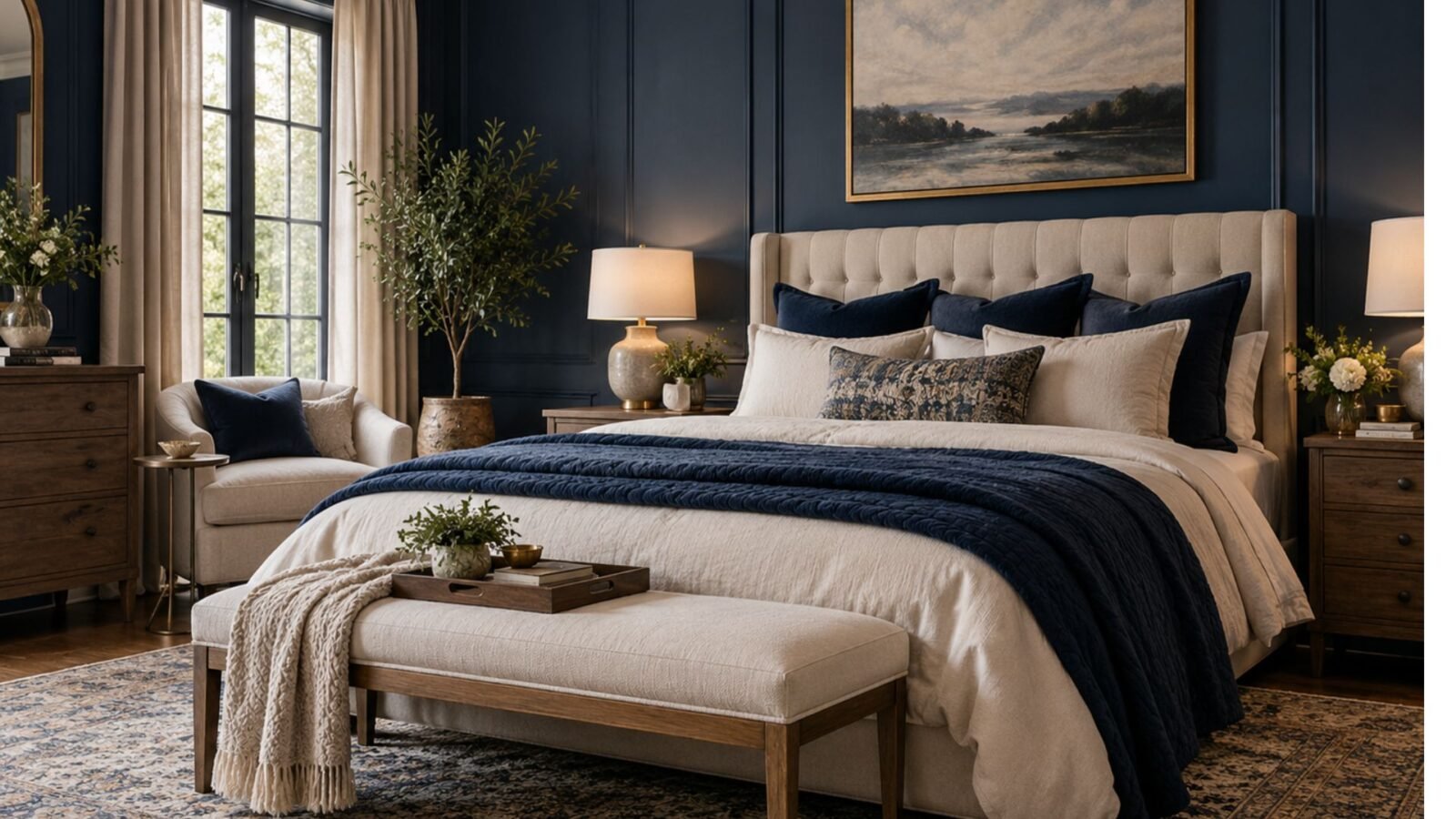

From dramatic navy walls to warm wood furniture and beautiful color combinations, discover how to make deep blue work in your bedroom.
- Why Navy Blue Works So Well in Bedrooms
- 12 Navy Bedroom Ideas for Different Design Styles
- 1. Create an elegant navy and ivory bedroom with wall paneling
- 2. Make the ceiling the statement with navy blue paint
- 3. Combine navy and walnut for a luxurious modern bedroom
- 4. Create a relaxed navy coastal bedroom with classic stripes
- 5. Pair navy and terracotta for a Mediterranean-inspired bedroom
- 6. Use navy built-in storage in a small bedroom
- 7. Pair navy with camel leather in an industrial bedroom
- 8. Introduce traditional drama with navy chinoiserie wallpaper
- 9. Create a navy and rust bedroom with Southwestern character
- 10. Color-drench a traditional bedroom in deep navy
- 11. Pair navy with pale pink in a contemporary bedroom
- 12. Design a navy twin guest bedroom beneath a sloped attic ceiling
- What Colors Go Best with Navy Blue in a Bedroom?
- How to Choose the Right Navy Blue Paint
- Start with the undertone
- Understand light reflectance value
- Test navy in different lighting conditions
- Consider paint sheen
- Will Navy Blue Make a Small Bedroom Look Darker?
- Where to Use Navy Blue Without Painting Every Wall
- Budget-Friendly Navy Bedroom Decorating Ideas
- The Wallsaide Navy Bedroom Balance Check
- Common Navy Bedroom Decorating Mistakes
- Choosing a navy that looks black in your lighting
- Combining too many dark finishes
- Overusing nautical decorations
- Forgetting about warm materials
- Relying on one overhead light
- Ignoring the furniture layout
- Frequently Asked Questions About Navy Bedrooms
- Is navy blue a good color for a bedroom?
- What colors go best with navy bedroom walls?
- Does navy blue make a bedroom look smaller?
- Is navy too dark for a small bedroom?
- What color furniture looks good with navy walls?
- What color bedding works with a navy bedroom?
- Is navy better than lighter blue for a bedroom?
- How do I make a navy bedroom feel cozy?
- Can I use navy blue without painting?
- Final Thoughts
- About the Author
Navy bedroom ideas can transform a room into a sophisticated retreat without making it feel cold or overly formal. This deep blue works beautifully with ivory, walnut, warm oak, brass, terracotta, and even pale pink. The right combination can feel elegant, cozy, contemporary, or relaxed.
But decorating with navy requires more than choosing a dark blue paint. Its undertones, the amount of natural light, and the contrast between furniture and walls all influence the finished room.
These 12 navy bedroom ideas show how to use the color in distinctive ways, from classic paneled bedrooms to modern apartments and compact guest rooms.

Why Navy Blue Works So Well in Bedrooms
Navy brings depth to a bedroom without requiring the entire palette to become dark.
Unlike brighter blues, navy can act almost like a neutral when paired with natural wood, cream upholstery, or understated textiles. It also creates a strong background for artwork, lighting, and architectural details.
The exact shade matters. Some navy paints have cool gray undertones, while others lean toward violet, green, or a cleaner, more saturated blue.
A navy that looks richly blue in daylight may appear almost black after sunset.
That isn’t necessarily a problem. An atmospheric bedroom can be comfortable and visually interesting when its furniture, bedding, and lighting are thoughtfully balanced.
If you’re still comparing lighter and darker blues, explore our blue bedroom ideas guide. It covers everything from powder blue and dusty blue to cobalt and slate.
For this guide, the focus is specifically on how to decorate successfully with navy.
12 Navy Bedroom Ideas for Different Design Styles
These navy bedroom ideas explore twelve different approaches. Each uses the color in a distinct architectural or decorative role, so you can choose a look that suits your room rather than simply copying a paint shade.
1. Create an elegant navy and ivory bedroom with wall paneling

Navy wall paneling can turn a simple bedroom into a space that feels more architectural and refined.
Instead of relying on an ordinary accent wall, introduce rectangular wall molding behind the bed. Paint both the wall and molding in the same deep navy to create a continuous finish.
An ivory upholstered bed adds contrast, while bronze wall sconces create warm points of light.
Keep the bedside tables relatively simple. The paneling should provide the visual detail, allowing the furniture to remain understated.
This approach works well in traditional, transitional, and contemporary-classic interiors.
Recreate the look: Use a matte or low-sheen navy paint, simple applied molding, ivory upholstery, and warm metal lighting. Add a textured cream duvet and avoid introducing too many additional patterns.
2. Make the ceiling the statement with navy blue paint
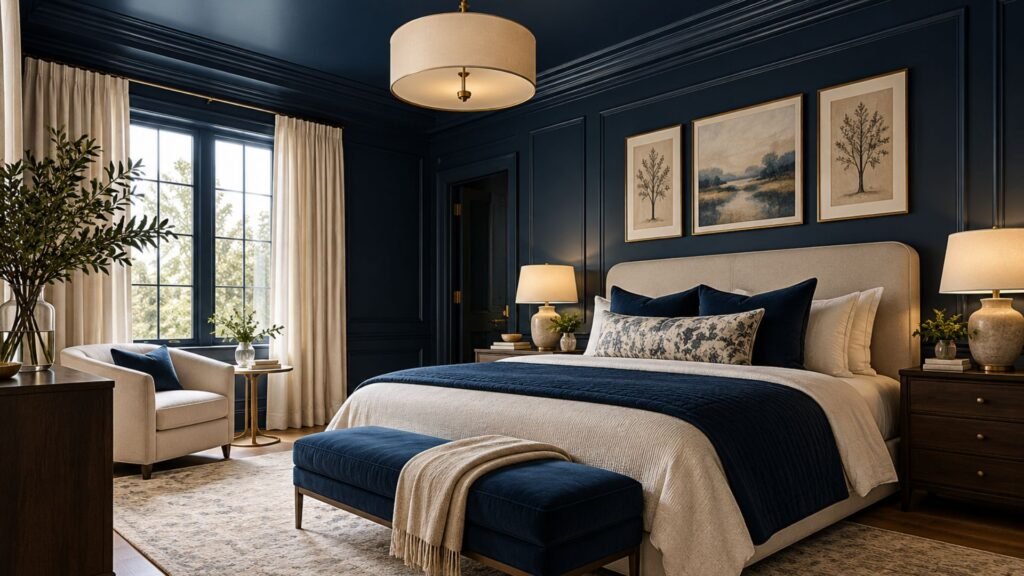
A navy ceiling creates a completely different atmosphere from the usual dark accent wall.
Keeping the walls warm white allows the ceiling to become the defining architectural feature. Pale oak furniture and cream bedding introduce warmth below the darker surface.
This approach can look particularly striking in a room with tall windows, simple walls, and a ceiling that has enough visual presence to carry the color.
A sculptural pendant can connect the ceiling to the furnishings without requiring additional decorative elements.
The result feels modern and considered rather than conventionally decorated.
Recreate the look: Test your navy paint on the ceiling before committing. Pair it with warm white walls, light timber furniture, and a simple bed silhouette. Choose lighting that creates a comfortable atmosphere after dark.
3. Combine navy and walnut for a luxurious modern bedroom

Navy and walnut are a particularly sophisticated combination because the cool depth of blue contrasts with the warmth of dark timber.
In a modern bedroom, navy upholstered wall panels can form an architectural backdrop for a low cream bed.
Walnut cabinetry, floating bedside furniture, and bronze pendants bring warmth without disrupting the restrained palette.
The materials should feel substantial, but their shapes can remain clean and uncomplicated.
For a more elevated look, use one large navy upholstered element rather than several small matching accessories.
Recreate the look: Choose a navy headboard or upholstered feature wall, walnut nightstands, warm ivory bedding, and subtle bronze lighting. Keep artwork limited and allow the materials to create interest.
Our luxury bedroom ideas guide explores additional ways to make a bedroom feel sophisticated without excessive decoration.
4. Create a relaxed navy coastal bedroom with classic stripes

Navy can create a beautiful coastal bedroom without relying on obvious nautical decorations.
Start with warm white painted walls and pale wooden flooring. Introduce navy through a striped upholstered headboard, a simple quilt, or a substantial piece of furniture.
Natural linen curtains and woven lighting provide texture, while a vintage wooden chest can make the room feel more personal.
The most successful coastal interiors suggest their setting through materials and light rather than decorating every surface with nautical motifs.
Recreate the look: Choose one navy striped textile, warm white walls, light wood furniture, and natural woven materials. Keep the rest of the bedding relatively simple.
If the room already has wooden beams or painted timber, allow those architectural details to remain visible.
5. Pair navy and terracotta for a Mediterranean-inspired bedroom

Navy and terracotta create a strong contrast between cool blue and warm earthy orange.
In a Mediterranean-inspired bedroom, a navy-painted alcove can frame the bed against soft plaster walls.
Terracotta flooring gives the room warmth, while rustic timber and natural linen prevent the color combination from feeling overly polished.
Curved architectural details, such as an arched headboard niche, can make the room feel distinctive without requiring elaborate furniture.
The key is using navy in a defined area rather than repeating it across every accessory.
Recreate the look: Paint an alcove or headboard wall navy. Combine it with warm cream, clay-colored textiles, and natural wood. If you cannot change the flooring, introduce terracotta through a large rug or a small number of decorative objects.
6. Use navy built-in storage in a small bedroom
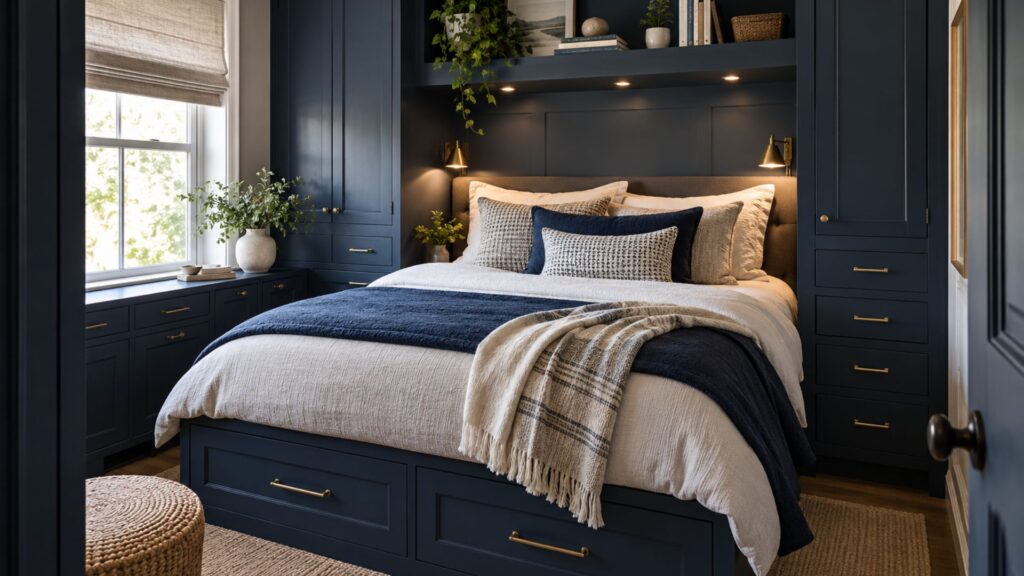
Small navy bedroom ideas work best when the color and storage are planned together.
Instead of filling the room with separate wardrobes, bedside tables, and cabinets, consider a fitted storage wall around the bed.
Painting the cabinetry navy can turn practical storage into a coordinated architectural feature.
A cream upholstered headboard provides contrast, while integrated bedside shelves and lighting reduce the need for extra furniture.
The design should still prioritize circulation. Built-in storage that blocks movement or makes the bed difficult to access won’t improve the room.
Recreate the look: Choose flat-front navy wardrobes, discreet handles, concealed storage, and warm lighting. Use light bedding to separate the bed from the dark cabinetry.
Before ordering fitted furniture, measure the room carefully and confirm door clearances.
For more compact-room solutions, explore our small bedroom ideas guide.
7. Pair navy with camel leather in an industrial bedroom

Navy takes on a completely different character when paired with concrete, leather, and steel.
In an industrial-style bedroom, matte navy walls can create depth without competing with exposed architectural materials.
A camel leather bed brings warmth to the palette, while black-framed windows and simple steel lighting establish a contemporary edge.
Oversized artwork can add contrast and personality without requiring multiple patterns.
The room should feel architectural rather than heavily decorated.
Recreate the look: Pair navy walls with a leather upholstered bed, black metal lighting, concrete or stone details, and warm neutral bedding.
Avoid introducing too many industrial accessories. Let the architecture and furniture create the look.
8. Introduce traditional drama with navy chinoiserie wallpaper
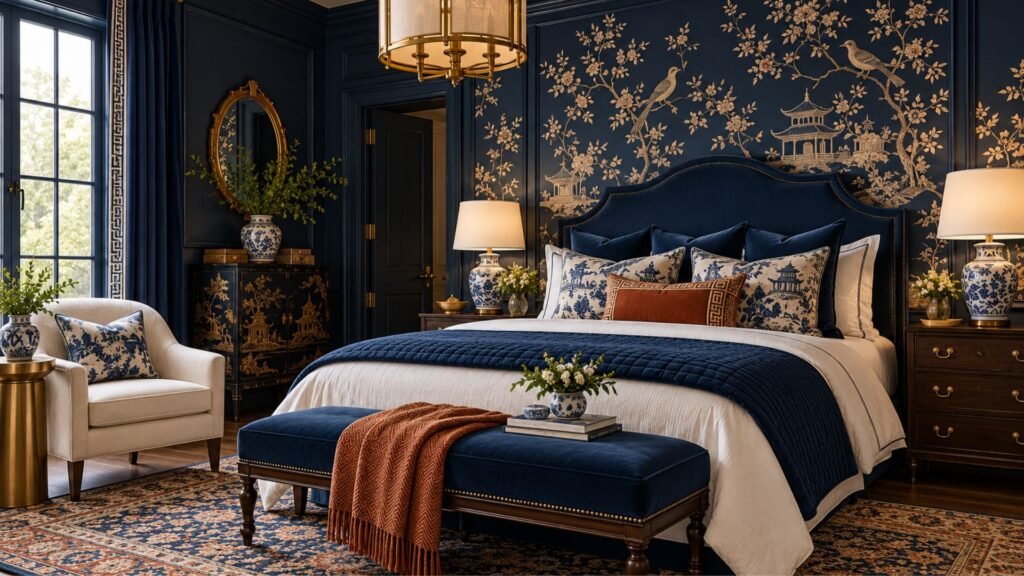
Navy patterned wallpaper can create a rich, decorative bedroom with a sense of history.
Chinoiserie-inspired wallpaper often features flowering branches, birds, and scenic details against a colored background.
In a bedroom, a navy version can become the primary decorative feature.
Antique mahogany furniture, cream bedding, and aged brass fittings complement the pattern without competing with it.
The main challenge is controlling the remaining decoration.
If the wallpaper is detailed, keep the curtains and bedding relatively restrained.
Recreate the look: Choose navy chinoiserie wallpaper for a feature wall or an architecturally defined area. Add traditional wooden furniture, warm lighting, and simple cream bedding.
Allow the wallpaper to remain the visual centerpiece.
9. Create a navy and rust bedroom with Southwestern character
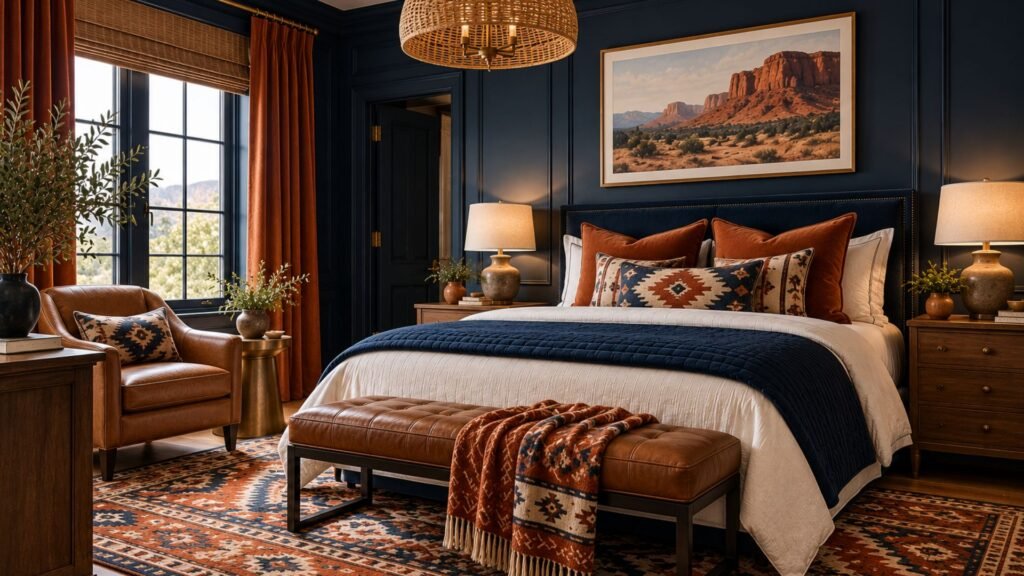
Navy and rust make an unexpectedly expressive combination.
In a Southwestern-inspired bedroom, navy can appear through the bed upholstery while warm adobe walls provide the main background.
Rust-colored textiles, sculptural wood furniture, and woven materials reinforce the earthy palette.
A patterned rug can connect the colors, but it should not introduce too many unrelated shades.
The furniture can remain contemporary, avoiding the need to recreate a heavily rustic interior.
Recreate the look: Choose a navy upholstered bed, rust-colored throw, sand-toned walls, and natural wood furniture. Add one statement artwork piece with blue and warm earth tones.
Keep the number of decorative elements limited so the palette remains clear.
10. Color-drench a traditional bedroom in deep navy

A color-drenched navy bedroom uses the same paint color, or closely related shades, across multiple architectural surfaces.
Instead of contrasting white trim against dark walls, the doors, molding, and ceiling can all become part of one continuous navy scheme.
This approach can be especially attractive in a traditional room with decorative woodwork and high-quality vintage furniture.
Ivory bedding, carved oak, and antique brass lighting provide contrast.
The result can feel intimate and enveloping rather than visually busy.
Recreate the look: Test navy on the walls and trim, then consider whether to continue it across the ceiling. Choose contrasting bedding and layered lighting to ensure the room remains usable after sunset.
If painting the entire room feels too permanent, start with the walls and trim before extending the color overhead.
11. Pair navy with pale pink in a contemporary bedroom

Navy and pale pink can create a bedroom that feels sophisticated, playful, and contemporary.
A navy geometric feature wall provides strong color and architectural structure.
A pale pink upholstered bed introduces softer shapes and a lighter visual element.
Light oak furniture and white sculptural lighting prevent the two colors from becoming overwhelming.
This is not a traditional blush-and-navy scheme built around ornate furniture. Its personality comes from clear shapes, proportion, and carefully controlled color.
Recreate the look: Use navy on one wall or architectural feature, introduce pale pink through the bed or one substantial chair, and keep the remaining furniture simple.
Avoid matching every accessory to the pink or navy. A little contrast will make the design more interesting.
12. Design a navy twin guest bedroom beneath a sloped attic ceiling
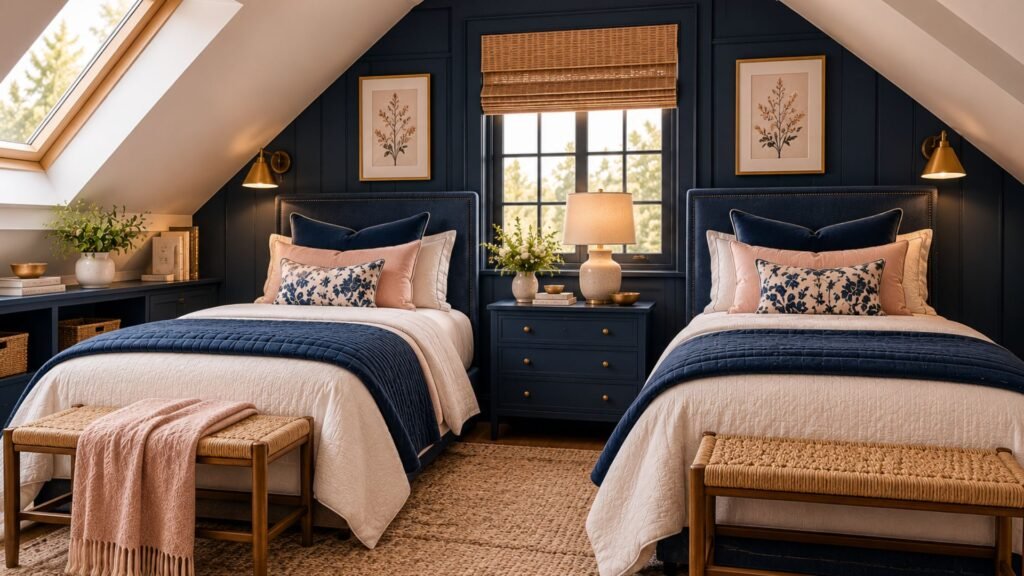
Navy can provide a strong visual anchor in an attic guest bedroom without covering every wall.
Two matching navy upholstered twin beds create a coordinated composition beneath sloped ceilings.
Warm white walls and ceilings preserve contrast, while exposed timber beams add character.
A shared nightstand and matching wall-mounted reading lights can make the arrangement practical and balanced.
The challenge is ensuring the room works comfortably around the roof slope.
Bed placement should consider headroom, access, and the positions of windows and doors.
Recreate the look: Choose relatively low twin beds, cream striped bedding, compact reading lights, and a shared wooden nightstand. Allow the timber and roof architecture to provide much of the character.
What Colors Go Best with Navy Blue in a Bedroom?
The most effective navy bedroom ideas combine deep blue with materials and colors that establish a deliberate relationship.
Navy can be paired with both warm and cool tones, but each combination creates a different atmosphere.
| Navy combination | Overall atmosphere | Best supporting materials |
|---|---|---|
| Navy + ivory + brass | Timeless and elegant | Linen, aged brass, wool |
| Navy + walnut + cream | Rich and sophisticated | Walnut, bronze, textured upholstery |
| Navy + warm white + oak | Fresh and coastal | Oak, cotton, woven fibers |
| Navy + terracotta | Earthy and distinctive | Clay, plaster, rustic timber |
| Navy + camel leather | Modern and tailored | Leather, steel, concrete |
| Navy + rust + sand | Warm and expressive | Woven textiles, natural wood |
| Navy + pale pink | Soft and contemporary | Upholstery, pale oak, ceramics |
| Navy + ochre | Bold and energetic | Velvet, brass, warm timber |
Navy and cream
Cream is one of the most versatile partners for navy.
It provides enough contrast to define the bed and furniture without creating the sharp appearance of brilliant white.
Cream bedding, curtains, and upholstered pieces can soften a navy bedroom, particularly when combined with warm lighting.
Explore our cream bedroom ideas guide for more ways to use warm neutrals.
Navy and brown
Navy and brown create a rich, grounded palette.
Walnut furniture tends to make navy feel more substantial and refined, while pale oak can create a lighter contemporary look.
Chocolate brown velvet or cognac leather can also introduce warmth.
For additional inspiration, see our brown bedroom ideas guide.
Navy and gold
Brass and gold-toned finishes introduce warmth against deep blue.
However, you don’t need matching metallic details throughout the room.
A pair of bedside sconces, cabinet handles, or one pendant light may provide enough contrast.
Choose a consistent metal finish where possible rather than mixing numerous unrelated tones.
Navy and gray
Gray can complement navy, particularly in modern interiors.
The challenge is ensuring enough contrast between darker surfaces.
If navy walls sit beside charcoal furniture and dark gray bedding, the room may feel visually flat.
Consider lighter gray, ivory, or natural wood to create separation.
How to Choose the Right Navy Blue Paint
Choosing navy paint is more complicated than choosing a color that looks attractive on a screen.
Deep blue paints can behave very differently in changing light, and subtle undertones can become surprisingly noticeable beside existing furniture.
Start with the undertone
Some navy paints lean toward violet, while others contain subtle gray or green undertones.
These differences can affect the way the paint looks beside flooring, upholstery, and wood finishes.
For example, Sherwin-Williams Naval SW 6244 is a deep blue with cool gray-green undertones.
Compare this type of navy with a cleaner blue or one that has a more violet character before deciding.
The goal is to find a shade that works with the finishes you already own.
Understand light reflectance value
Light reflectance value, or LRV, measures the percentage of visible light a paint color reflects under standardized conditions.
Lower-LRV paints generally appear darker because they reflect less light.
For a specific example, Benjamin Moore Hale Navy HC-154 has an LRV of 8.36.
This makes it a useful reference when comparing deeper navy paints with lighter blue alternatives.
However, LRV doesn’t tell you whether the paint will look attractive in your room. Natural light, artificial lighting, furniture, and nearby colors all influence the final effect.
Test navy in different lighting conditions
A deep blue that appears rich in daylight may look nearly black after sunset.
That’s why paint testing matters.
Benjamin Moore’s guide to using paint color samples recommends examining larger samples in different locations and lighting conditions.
For your bedroom, compare samples during the morning, afternoon, and evening.
Switch on the lamps you normally use and evaluate the color beside the bed, flooring, curtains, and furniture.
If the navy loses too much of its blue character, consider a slightly lighter or more saturated alternative.
Consider paint sheen
Paint finish affects the way a navy surface reflects light.
A matte or low-sheen finish often creates a softer appearance on bedroom walls.
A satin or semi-gloss finish can make architectural trim, doors, or cabinetry appear more defined.
Choose a finish suitable for the surface and maintenance requirements rather than selecting sheen purely for its visual effect.
Will Navy Blue Make a Small Bedroom Look Darker?
Navy can make a small bedroom feel more enclosed, particularly when it covers several walls and is combined with dark furniture.
But that doesn’t automatically make the design unsuccessful.
An intimate, darker atmosphere may be exactly what you want.
The important part is balancing the color with the room’s physical dimensions, natural light, and furniture.
If you’re unsure about painting the whole room, start with a navy upholstered bed, fitted wardrobe, or accent wall.
Cream bedding, light flooring, and well-positioned lamps can introduce visual contrast.
Furniture scale is equally important. A bulky bed or oversized storage unit can make a small room feel crowded regardless of wall color.
Prioritize comfortable circulation, accessible storage, and useful lighting before decorative details.
Where to Use Navy Blue Without Painting Every Wall
You can introduce navy through several different elements.
Navy upholstered bed: A substantial navy headboard creates a focal point against cream or warm-white walls. Textured linen gives a relaxed look, while velvet feels richer.
Navy wardrobes: Painted cabinetry can turn functional storage into an architectural feature. This is especially effective when the doors have simple profiles and discreet hardware.
Navy curtains: Floor-length navy curtains can frame windows and add visual depth. Consider how much daylight they block when closed.
Navy bedding: A duvet, quilt, or large throw can establish the palette without permanent changes. Balance the color with ivory, oatmeal, or subtle patterns.
Navy artwork: One oversized piece containing navy can connect a neutral bedroom to deeper blue accents elsewhere.
Choose one or two substantial uses of navy instead of matching every accessory to the same shade.
Budget-Friendly Navy Bedroom Decorating Ideas
A navy bedroom doesn’t require new furniture or a complete renovation.
Start with the largest element you can change affordably.
Painting an existing dresser navy can introduce meaningful color while preserving functional storage.
A simple upholstered headboard can provide a focal point against neutral walls.
If painting isn’t practical, try navy bedding or curtains combined with warm white and wood.
Secondhand brass lighting and vintage wooden furniture can create an interesting contrast without requiring a matching bedroom set.
Before purchasing accessories, assess your existing furniture and identify what the room actually lacks.
For comfortable, layered decorating inspiration, explore our cozy bedroom ideas guide.
The Wallsaide Navy Bedroom Balance Check
Before considering your room finished, review four practical decisions.
1. Identify the dominant navy element.
Is navy the wall color, the main upholstery, or a supporting accent? It should have a clear purpose within the design.
2. Check the contrast.
Can you easily distinguish the bed and major furniture from the walls? If not, introduce lighter upholstery, bedding, or a contrasting material.
3. Review the lighting after dark.
Dark paint changes character at night. Use bedside lamps, wall sconces, and other appropriate light sources to create a comfortable atmosphere.
4. Confirm the room functions well.
Check circulation, bedside access, storage, lighting controls, and furniture proportions.
A visually attractive bedroom should also work comfortably every day.
Common Navy Bedroom Decorating Mistakes
Choosing a navy that looks black in your lighting
Very dark blue can lose much of its visible color in a room with limited light.
Test physical samples before painting and observe them under artificial lighting.
Combining too many dark finishes
Navy walls, charcoal bedding, black furniture, and dark flooring can make the room appear visually heavy.
Add contrast strategically rather than making every surface pale.
Overusing nautical decorations
Navy doesn’t require anchors, ropes, sailboats, and stripes across every surface.
A coastal style can be communicated more subtly through wood, linen, and restrained pattern.
Forgetting about warm materials
Navy, gray, and bright white can produce a cool palette.
Walnut, oak, camel leather, warm ivory, or brass may introduce a more comfortable balance.
Relying on one overhead light
A single ceiling fixture may not provide useful lighting for reading, dressing, or relaxing.
Layer lighting according to the room’s functions.
Ignoring the furniture layout
A large bed, oversized nightstands, or deep wardrobes may restrict movement.
Measure furniture and circulation before investing in new pieces.
Frequently Asked Questions About Navy Bedrooms
Is navy blue a good color for a bedroom?
Yes. Navy can work in traditional, contemporary, modern, coastal, and vintage bedrooms. Its success depends on the shade, furniture, lighting, and supporting color palette.
What colors go best with navy bedroom walls?
Cream, ivory, warm white, walnut, oak, camel, terracotta, muted pink, and brass can all work well. Choose supporting colors according to the atmosphere you want.
Does navy blue make a bedroom look smaller?
Not necessarily. Navy can create a more enclosed appearance, but furniture size, layout, contrast, and lighting also influence how spacious a bedroom feels.
Is navy too dark for a small bedroom?
Not automatically. A small navy bedroom can feel intimate and well designed when the furnishings, lighting, and storage are carefully planned. If you prefer a brighter room, use navy on a single feature or upholstered element.
What color furniture looks good with navy walls?
Ivory upholstery, walnut, light oak, cognac leather, painted cream furniture, and selected metal finishes all complement navy.
What color bedding works with a navy bedroom?
Cream, ivory, warm white, oatmeal, soft beige, and some muted gray textiles can balance navy walls. Rust, terracotta, or pale pink can introduce warmer accents.
Is navy better than lighter blue for a bedroom?
Neither is universally better. Navy provides greater depth and contrast, while lighter blue often creates a softer appearance. Your preference, natural light, and furnishings should determine the choice.
How do I make a navy bedroom feel cozy?
Combine navy with warm lighting, comfortable bedding, tactile materials, and natural wood. Layering fabrics and using several appropriate light sources can help the room feel inviting.
Can I use navy blue without painting?
Yes. A navy upholstered bed, curtains, bedding, rug, or painted furniture can introduce the color while leaving the walls neutral.
Final Thoughts
The strongest navy bedroom ideas use deep blue as part of a considered design rather than treating it as the only feature.
Classic paneling creates elegance. Walnut and upholstered walls produce a refined modern look. Navy stripes can feel relaxed and coastal, while color drenching creates a more atmospheric bedroom.
The difference comes from how the navy interacts with materials, light, furniture, and architecture.
Choose the right undertone first, decide where the color should appear, and balance it with materials that create sufficient warmth and contrast.
Whether your bedroom is spacious or compact, navy can provide a distinctive foundation for a room that feels comfortable, personal, and thoughtfully finished.
For the broader decorating process, explore our bedroom ideas guide.
About the Author
Emma Carter writes about interior design, color palettes, furniture, and practical decorating for Wallsaide. Her guides help readers understand why design choices work and how to adapt beautiful interiors to their own homes.